
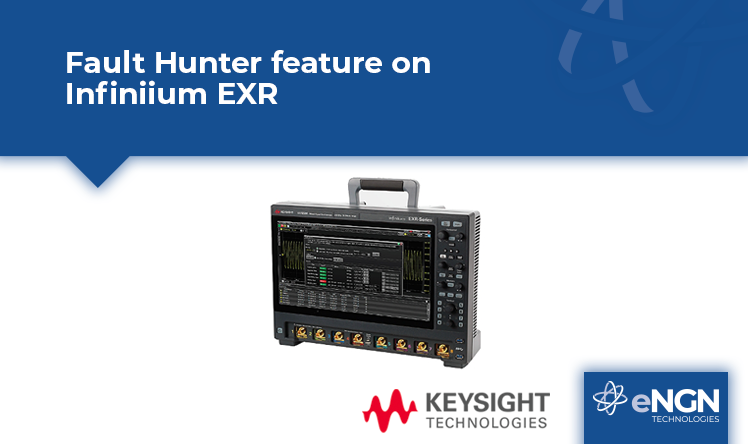
Keysight’s Fault Hunter is a new oscilloscope feature to quickly locate and identify electronic faults by automatically setting up advanced triggers.
Once started, Fault Hunter uses de first 30 seconds to learn a normal signal, then compare subsequent waveforms to catch up to six waveform anomalies. Also, it can compare waveforms for 1 to 2,880 minutes.
Fault hunting
Troubleshooting, testing design ideas, or performing quality assurance is time-consuming.
If you do not know what you are looking for in a problematic signal, you could spend hours trying to find it.
The Infiniium EXR-Series oscilloscope learns the signal first to determine which sections of the signal are anomalies. Fault Hunter automatically determines what is typical of the signal under test based on measurements like pulse width, rise time, and fall time.
The following are six signal types that Fault Hunter may find:
- Glitch (positive or negative) is a pulse-width trigger that focuses on a pulse of a width that is thinner than normal pulses.
- Runt (positive or negative) is a pulse-width trigger that focuses on height rather than width. A trace that does not reach the expected height triggers on the runt or the smaller trace.
- Slow-rising or slow-falling edges are triggers related to the slew rate of the signal.
If Fault Hunter finds an anomaly in the signal, it stops and saves the waveform for analysis. Fault Hunter enables you to examine the conditions around rare anomalies so you can quickly share it with others on your project team. You can take a screenshot of the Infiniium oscilloscope’s display to use in your presentation for discussion in a design review or as evidence in a quality assurance (QA) audit.
Hunting for signal errors is tedious and time-consuming. Fault Hunter helps you find and resolve complex signal issues quickly. An intermittent problem can be challenging to locate if your oscilloscope does not capture it. Fault Hunter solves this problem by automatically applying advanced triggers to capture a normal signal for comparison.
Find out more here.